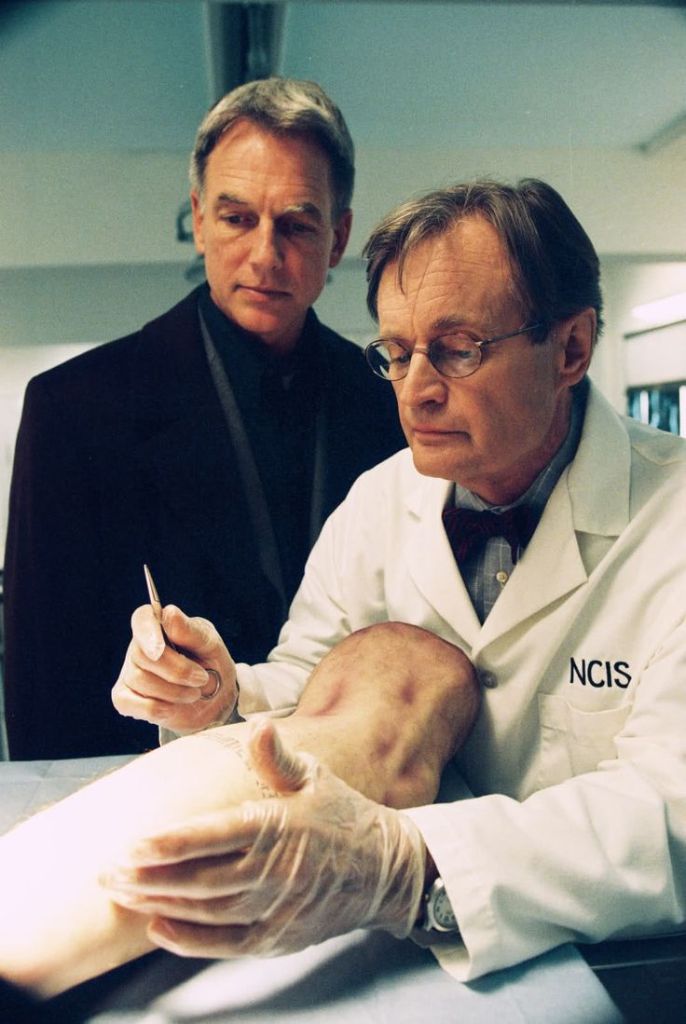
Screenshot from NCIS, © CBS Studios. Used under fair use for commentary/criticism.
When people think of a forensic pathologist, they likely think of a doctor with a scalpel and a patient lying on a metal exam table. They may picture a scene from a show like NCIS, where the autopsy performed by the pathologist is artfully shown so as not to violate TV rules about gore. Historically, the only way to do an autopsy was to cut open the body and search for clues to confirm the cause and manner of death. Unfortunately, as with any type of evidence retrieval, it’s an inherently destructive process…obviously. But these days, there are ways to use technology in order to supplement or even replace the need to actually cut open a body, as well as processes to help a forensic pathologist be even more accurate about what happened after a person’s death.
The first technological advancement we’re going to talk about is virtopsy. Short for “virtual autopsy”, this technology was developed starting in the early 2000’s. Dr. Richard Dirnhofer and his team at the University of Zurich began using CT and MRI to image bodies, and they found that the images produced were in some ways even better than traditional autopsy at finding bullet trajectories and fractures, among other things, without the destruction that would come with a traditional autopsy. They also found that when judges and juries are shown 3D images of autopsy, it can help clarify where and how injuries or other significant events happened without subjecting them to the images that would be taken during a traditional autopsy. This technology has even been used to conduct evaluations of ancient remains such as King Tut and other Egyptian mummies as well as the Medici family, one of Italy’s most powerful families.
Another technology that’s constantly evolving is mass spectrometry. Very briefly, mass spectrometry breaks down a sample and separates the molecules by charge and size, which creates a chemical “fingerprint” that allows a trained chemist to identify a specific compound, such as a drug or poison in the body. This allows a forensic pathologist to rule in or out certain causes of death, and might indicate or rule out foul play. Mass spectrometry has evolved to detect substances even when you only have a few parts per trillion (meaning if you have one molecule, it can be identified among a trillion others). Obviously, this has allowed forensic pathologists to make huge strides in identifying how and why people died. The amount and type of bacteria can give forensic pathologists an idea of how long a person has been dead. (This is true until a person is decomposed past when a forensic pathologist can help, at which point a forensic anthropologist would likely take over.) The thanatomicrobiome can help provide an extremely accurate time of death when compared to traditional methods. Since it is a relatively new discovery, it still has some refinement to go through before it’s admissible in court, but it will likely turn out to be extremely helpful.
Of course, in 2025, we can’t write about technological advances without writing about AI. Artificial intelligence is making huge strides every day, and while it has a long way to go, it may not be long before we are seeing it used as a tool to supplement forensic pathologists, as well as other specialties within the forensic field. It could be used to interpret images, help write autopsy reports, and sort through cold case evidence to make any connections possible…and by no means is that an exhaustive list. There are still many, many concerns with the use of AI, and many more things to address before it’ll be widely accepted, but it’s likely that in the future we’ll see AI supplementing forensics.
These are just a few examples of the groundbreaking advancements in science and technology that are empowering forensic pathologists to make more accurate, efficient, and informed determinations in their work. As these tools continue to evolve, they promise to enhance forensic investigations and contribute to the pursuit of justice with greater precision and reliability.
 The Evidence Locker
Leave a comment